

Foreword
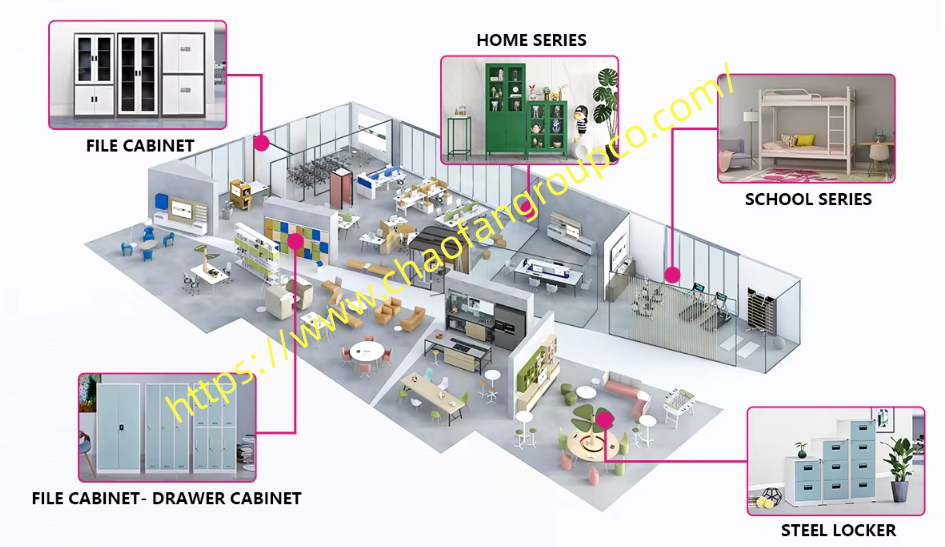
Luoyang is one of China’s largest production bases for steel office furniture/metal cabinets: file cabinet / steel lockers/ drawer cabinets/ Shelving / Steel cupboard /Wardrobe / steel Bed ETC, with a mature industrial chain and a coexistence of large factories and small workshops. Due to intense competition, product prices and quality vary greatly. This article summarizes common industry practices and key purchasing points to help consumers avoid pitfalls.
I. Common Problems and Inside Stories
- Mislabeled Steel Plate Thickness
Steel plate is the core cost of sheet metal cabinets, and mislabeling thickness is the most common problem.
- Common Methods:
- Using the thickness of the bare plate before powder coating to imitate the finished product thickness;
- Using the total thickness after powder coating as the nominal value;
- Directly exaggerating the value, actually using less material.
- Impact:
Thin steel plates lead to poor cabinet load-bearing capacity, easy deformation, soft door panels, and wobbling after long-term use.
- Differences in Steel Plate Material
Even among “cold-rolled steel plates,” there are significant differences in quality.
- High-quality steel plates: Cold-rolled plates from reputable steel mills, flat, with good toughness, and not prone to rust.
- Inferior steel plates: Recycled materials, secondary plates, or rusted plates, with inadequate pickling and phosphating treatment. The defects may not be immediately apparent, but they will rust from the inside over time.
- Differences in Powder Coating Processes
Surface powder coating directly affects environmental friendliness and durability.
- Powder Coating Quality: High-quality environmentally friendly powder coating has a low odor and strong adhesion; inferior powder coating has a pungent odor and is prone to peeling and discoloration.
- Coating Thickness: Small factories apply a thin coating to save costs, often leaving corners or the back uncoated, resulting in poor rust prevention.
- Pre-treatment: Reputable factories perform degreasing and phosphating treatments; small factories may simply wipe the surface and then spray directly, leading to peeling later.
- Structural Cost-Cutting
Similar appearances can have significant internal differences.
- Reinforcing Ribs: High-quality cabinet shelves and doors have reinforcing ribs on the inside, providing good load-bearing capacity; inferior cabinets lack reinforcing ribs, causing shelves to bend when heavy objects are placed on them.
- Welding Quality: Large gaps between spot welds, small weld points, or incomplete welds result in an unstable cabinet body.
- Back Panel: Low-priced cabinets have extremely thin back panels (even around 0.3mm), easily dented with a light press.
- Shelf Adjustment: Some cabinet shelves have thin fixings or clips, resulting in poor load-bearing capacity.
- Downgraded Locks and Hardware
The prices of hardware components such as locks, handles, drawer slides, and hinges vary significantly.
- Cheap locks are prone to breakage, but key compatibility is high; high-quality locks offer better security and smoother operation, but are more expensive.
- For cabinets with drawers or sliding doors, the quality of the drawer slides significantly affects performance.
- OEM/ODM vs. “Factory Direct Sales”
- The same factory may manufacture for different brands, but the materials and standards differ.
- The same style may be produced for project orders, e-commerce versions, and offline versions, with completely different materials.
- The Logic Behind Low Prices
Cabinets of similar size and appearance can vary in price by several times, mainly due to differences in steel plate thickness, materials, painting processes, and the cost of hardware and structure. Low-priced cabinets often only “look” like they exist, with materials and workmanship significantly reduced. Some project orders are produced to the lowest possible standard due to bid-winning price reductions.
II. Purchasing Recommendations
- Inquire about steel plate thickness
Directly ask about the “bare plate thickness,” not just the nominal value. It’s best to request a test report or actual measurement.
- Compare weight
For cabinets of the same size, heavier ones usually use more substantial materials. For example, a high-quality 1.8-meter-high four-door filing cabinet typically weighs over 30kg.
- Check powder coating details
The surface should be smooth and uniform, without particles/drips/missing areas. Smell for any pungent odor when opening the door.
- Inspect the internal structure
Check if the shelves have reinforcing ribs, the thickness of the back panel, the uniformity of welds, and the neatness of door seams.
- Choose reputable channels and brands
Prioritize brands with physical factories, stable quality assurance, and a good reputation.
- Don’t just look at the price
Steel cabinets are durable goods. Cheap products may have problems after two or three years, leading to troublesome repairs. It’s better to buy a high-quality product from the start.
III. Conclusion
The metal cabinet industry in Luoyang is generally mature, but intense competition has led to widespread instances of shoddy workmanship. The key point is: you get what you pay for; the thickness of the steel plate, the material, the coating, and the hardware determine the quality. When purchasing, focus on these aspects and make a rational judgment based on your budget and intended use.
Read More:
Differences and purchasing guide between carbon steel and chromium-vanadium steel (CRV)
Poll: What salesperson behaviors do international buyer dislike?
Sharing some industry “secrets to low prices”: #Low-price trap
The customer who chose the lowest-priced supplier sent a message a year later
What is our comprehensive quality inspection process? – Tool cabinet/tool cart
How do we handle customer complaints (quality issues) – tool cabinet/tool cart?
As a foreign importer, what costs do you have to bear, especially the implicit costs?
Cost Reduction And Efficiency Improvement In Company Operations
Tool Cabinet / Tool Cart Buying Guide For Auto Repair Shop
Case Study on Supply Chain Cost Reduction and Efficiency Improvement
Customer question: Why is there such a big price difference for the same tool cabinet?
Tool Cabinet/Chest/Box Buying Guide
Tool Cabinet/Chest/Box Recommendations
How to identify your target customer base (in the tool cabinet industry)?