
The quality of after-sales service is a key indicator of a company’s responsibility and a significant test of its capabilities and reputation. When customers report quality issues after exporting tool cabinets/tool carts, we adhere to a set of core principles: “rapid response, clear responsibility, efficient resolution, and maintaining reputation.” With years of foreign trade experience, we have developed a standardized handling process that protects customer rights while minimizing our own losses.
I. Immediate Response and Customer Reassurance
24-Hour Contact: Upon receiving a customer complaint, the foreign trade or after-sales team must contact the customer within one business day to avoid delays that could escalate dissatisfaction. During the communication, apologize first, then clearly inform the customer: “We have taken this issue seriously and will immediately initiate the verification process. We will give you a preliminary response within 6 hours.”
Detailed Problem Information Collection: Obtain complete and accurate evidence of the quality problem from the customer to avoid misjudgments due to incomplete information:
○ Actual photos/videos of the product problem (clearly showing the location and extent of the defect, such as deformed tool cabinet doors, stuck drawer slides, peeling surface coating, etc.);
○ Order information (order number, shipping batch, product model, quantity);
○ Problem scenario (e.g., damage during transportation, inability to use after installation, malfunction occurring after N months/years of use);
○ Customer requests (e.g., replacement, return, resend of parts, compensation for repair costs, etc.).
II. Multi-dimensional Verification to Clarify Responsibility for Quality Issues
Responsibility for quality issues may fall into three categories: “Manufacturer Responsibility,” “Logistics Responsibility,” and “Improper Customer Use.” Each category needs to be investigated individually:
1.Internal Verification (Manufacturer’s Side)
○ Retrieve the production and quality inspection records for this batch of products to confirm whether there were any omissions in factory inspection (e.g., dimensional deviations, missing parts, substandard workmanship);
○ Verify the packaging plan to determine if insufficient packaging protection (e.g., lack of shock-absorbing foam, inadequate wooden crate reinforcement) led to transportation damage;
○ Investigate design defects. If multiple customers report similar issues (e.g., insufficient load-bearing capacity of the tool cart causing frame bending), it is necessary to assess whether the problem stems from product design or material usage.
2.Logistics Verification
Contact the logistics provider responsible for export, retrieve transportation tracks, loading and unloading records, and customs documents to confirm whether severe jolting, rough handling, or damage occurred during sea/land transportation, or during customs inspection.
3.Customer Usage Verification
If the customer’s feedback is related to the usage scenario (such as drawer deformation due to overloading, or component breakage due to improper installation), the product user manual, load-bearing parameters, and other relevant information must be provided. The usage specifications should be objectively explained, while subtly verifying whether the customer’s operation is compliant.
Third, provide targeted solutions based on the attribution of responsibility.
Based on the verification results, the solutions should be categorized and handled accordingly, taking into account both rationality and feasibility, and avoiding excessive compromise or forceful shirking of responsibility.
| Types of responsibility | Specific solutions | Precautions |
| Manufacturer’s responsibility (design/production/packaging issues) | Replacement/Reissue: We will replace the missing product or missing parts for the customer free of charge and cover the round-trip shipping costs; 2. Return and Refund: If the customer refuses to exchange the product, we will negotiate a return, provide a full refund, and cover the return shipping costs (for high-value products, we can assess whether they can be shipped back to China for refurbishment); 3. Repair Compensation: If the product can be repaired locally, we will cover the repair costs; 4. Upgrade Compensation: We will provide additional accessories/extend the warranty period to compensate for the customer’s losses and maintain long-term cooperation. | To avoid “delayed solutions,” clearly inform customers of the processing time (e.g., “replacement parts will be sent within 7 business days”); and update internal quality inspection standards in a timely manner to prevent similar problems from recurring. |
| Logistics liability (damage during transportation) | Assist customers in claiming compensation from logistics providers, providing documents such as proof of factory condition and packaging photos; 2. If the logistics compensation period is long, we can resend the products to the customer first, and then pursue compensation from the logistics provider ourselves; 3. In subsequent cooperation, we can change to a more reliable logistics provider or upgrade the packaging solution (such as adding wooden frames or steel straps). | Keep all logistics communication documents and clarify the logistics provider’s compensation terms to avoid incurring additional losses. |
| Improper use by customers | Provide technical support: Send detailed installation/usage tutorials to guide customers on proper operation; 2. Provide spare parts for a fee: Replace damaged spare parts for customers at cost price, and provide installation instructions; 3. Explain patiently: Explain product parameters with objective data (such as “the tool cabinet has a rated load capacity of 50kg, and using it with excessive weight will cause deformation”) to avoid escalating conflicts. | Use a tactful tone when communicating, avoid directly blaming the customer, and emphasize that “we are willing to help solve the problem.” |
IV. Solution Implementation and Closed-Loop Follow-up
1.Clarify Implementation Details
Sign a written solution confirmation letter with the client (email/contract acceptable), clarifying:
○ Solution content (e.g., reshipment of XX model parts);
○ Implementation timeline (e.g., shipping date, arrival date);
○ Cost responsibility (e.g., manufacturer bears shipping costs).
2.Follow Up Throughout the Process
○ After the product is reshipped, promptly provide the tracking number so the client can track it;
○ After the client receives the goods, proactively follow up to confirm whether the problem has been resolved and inquire if further assistance is needed.
3.Closed-Loop Processing
After the client confirms the problem has been resolved, compile a case file (including problem description, verification process, solution, and client feedback) and archive it.
V. Post-Incident Optimization to Prevent Recurrence of Similar Issues
1.Upgrade Product Quality Control
○ Optimize production processes for exposed problems (e.g., upgrade the spraying process and increase baking time for coating peeling);
○ Strengthen factory quality inspection processes and increase simulated transportation tests (e.g., vibration tests, drop tests) to ensure packaging and products can withstand long-distance transportation.
2.Improve Export Service System
○ Equip export products with multilingual user manuals and installation videos to reduce the probability of improper customer use;
○ Cooperate with local overseas repair service providers to provide localized after-sales support (applicable to regions with large market size);
○ Customize packaging solutions for different country transportation environments (e.g., use environmentally friendly wooden crates for shipments to Europe and America, and strengthen moisture-proof treatment for shipments to Southeast Asia).
3.Maintain Customer Relationships
After resolving the problem, regularly follow up with customers to understand their subsequent usage. Offer small gifts or discounts on the next order to turn negative events into opportunities to strengthen cooperation.
Here is one of our case studies for reference:
Our client is a large Dutch hardware chain. We’ve been cooperating for nearly eight years, since 2018, with consistently increasing orders each year. Over these years of cooperation and adjustment, the probability of quality issues has been very low—only four times in total.
One of these incidents was clearly our company’s responsibility: peeling/bubbling of the coating on the tool cabinet surface.
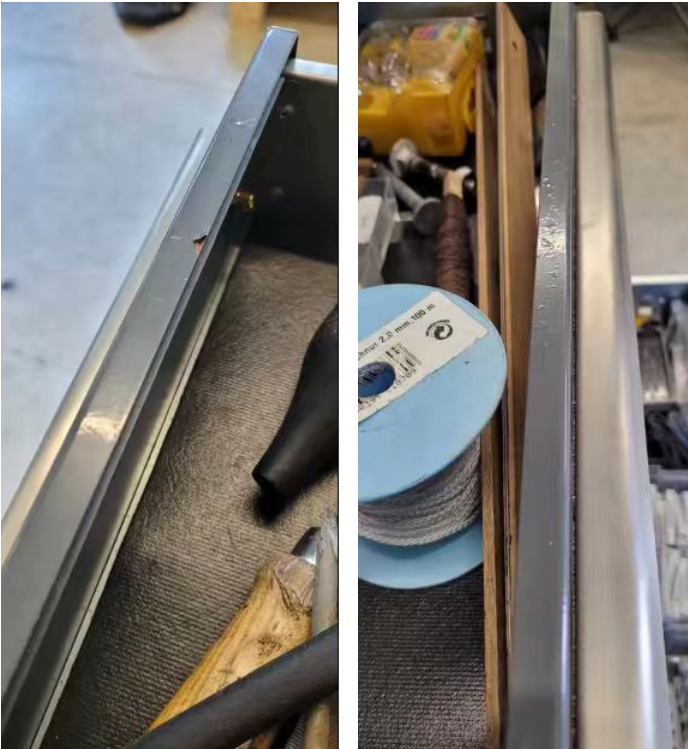
Following procedure, we immediately inquired about the batch number and quantity affected, then replied to the customer within 3 hours: free new drawers and accessories. The customer readily agreed.
Another instance where responsibility was unclear: Tool cabinet doors warped.
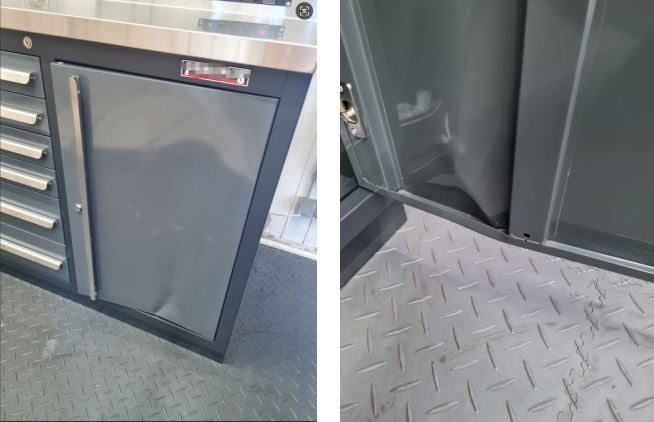
Because our company has strict quality control procedures, such incidents are unlikely to occur. It’s highly probable that the problem arose during transportation or unloading by the customer. Even so, our company has decided to provide free spare parts for the customer to install themselves.
The customer readily agreed.
And so, our cooperation continues.
Problems are not terrible; what’s terrible is being irresponsible to our customers and letting them down. Customer feedback is crucial to us, and we will continue to optimize our products and services to provide our customers with more reliable tool cabinet/tool cart solutions.
Read More:
What is our comprehensive quality inspection process? – Tool cabinet/tool cart
Cost Reduction And Efficiency Improvement In Company Operations
Tool Cabinet / Tool Cart Buying Guide For Auto Repair Shop
Case Study on Supply Chain Cost Reduction and Efficiency Improvement
Customer question: Why is there such a big price difference for the same tool cabinet?
Tool Cabinet/Chest/Box Buying Guide
Tool Cabinet/Chest/Box Recommendations
How to identify your target customer base (in the tool cabinet industry)?
Informe de análisis de ventas de armarios de herramientas en el mercado español 2025
Analyseverslag van de verkoop van gereedschapskasten op de Nederlandse markt 2024-2026
Analyserapport for det norske markedet for verktøyskap 2025
Informe de análisis de ventas de gabinetes de herramientas en el mercado mexicano 2022-2025
Relatório de Análise de Vendas de Armários de Ferramentas no Brasil-2024