

Quality Inspection Process Overview
Core Concept: Prevention first, inspection second, controlling quality problems at the earliest stage.
Process Main Flow: Incoming Material Inspection → Production Process Inspection → Final Finished Product Inspection → Packaging and Shipment Inspection
I. Incoming Material Inspection
Inspected before materials enter the production line, controlling quality from the source.
1.Sheet Metal Inspection:
Material and Thickness: Verify that the steel material (e.g., cold-rolled sheet, SPCC) and thickness meet the drawing requirements (using calipers or thickness gauges).
Surface Quality: Check for severe rust, dents, scratches, and paint peeling (for pre-coated sheets).
2.Purchased Component Inspection:
Slide Rails/Guide Rails: Randomly check for smooth extension and retraction, no jamming or abnormal noise, and whether the load test meets the standards.
Locks/Door Handles: Test whether the key opens and closes smoothly, and whether the latch pops out/retracts forcefully and completely. Check whether the handle is securely installed and whether the feel is comfortable.
Casters/Footplates: Check if the casters are the specified brand/load-bearing capacity, rotate smoothly, and have effective brakes. Check if the foot bolts adjust smoothly.
Hinges: Test the smoothness of opening and closing, checking for excessive tightness or looseness, and verify the limit function.
3.Inspection of Painted/Electrophoretic Parts:
Coating Appearance: Check if the color and gloss match the color sample. The surface should be smooth, free of runs, orange peel, particles, exposed substrate, color differences, and other defects.
Coating Performance: Periodically check adhesion (cross-cut test), hardness (pencil hardness tester), and thickness (thickness gauge).
II. Production Process Inspection
Inspection is conducted after key processes such as bending, welding, painting, and assembly.
1.Sheet Metal and Welding Process:
Dimensional Verification: Use measuring tapes and calipers to check key dimensions (such as cabinet diagonals and hole spacing) to ensure they meet the drawing tolerances.
Welding Quality: Check that weld points/seams are uniform and firm, without any incomplete welds, missed welds, burn-through, or weld spatter residue. After grinding, the surface should be smooth and flat.
Structural Symmetry: Check that door and drawer gaps are uniform.
2.Painting Process:
Pre-treatment: Confirm that pre-treatment such as degreasing and phosphating is in place.
Post-powder coating/painting: Similar to the “Painted Parts Inspection” in incoming material inspection, focusing on checking for missed areas and thin coatings in the fully covered areas and corners.
3.Assembly Process:
Component Assembly: Check that slides, drawers, doors, shelves, etc., are installed correctly, level, and firmly.
Functional Testing:
¡ Drawer Test: Perform a full-load (or specified load) push-pull test on each drawer, ensuring smooth operation without jamming or abnormal noise. The self-closing function (if applicable) should function normally, and the limit devices should be effective.
Door Panel Test: Perform an opening and closing test to check if the hinges are smooth, if the door closes tightly, and if the weatherstripping (if applicable) is evenly applied.
Lock Test: Repeatedly test the opening and closing of the main lock and drawer locks to ensure all locking points operate accurately and effectively.
Cassette/Foot Test: Perform a pushing test to check if the movement is flexible and if the brakes are secure when locked.
III. Final Product Inspection
A comprehensive inspection of the product before packaging, after all production processes are completed.
1.Comprehensive Appearance Inspection:
Walk around the product and inspect all exposed surfaces for scratches, dents, paint peeling, contamination, and obvious color differences.
Check that labels and tags (such as serial numbers and load-bearing markings) are firmly attached, correctly positioned, and with clear and accurate information.
2.Structural and Dimensional Verification:
Verify that the overall dimensions (length, width, and height) of the product meet the order requirements.
Check that the cabinet is stable and does not wobble when placed on a level surface.
3.Full Functional Inspection:
Repeat all functional tests conducted during the production process inspection, and add:
Load-bearing test (sampling/when requested by the customer): Perform static load tests on drawers, shelves, and the top of the cabinet to check for permanent deformation and functional failure.
Stability test: For the tool cart, check its structural stability in both stationary and moving states, and for any risk of tipping over.
4.Cleanliness and Integrity:
Check that the interior and exterior are clean, free of oil stains, dust, and fingerprints.
Ensure all accessories (such as keys, partitions, mounting screws, and instruction manuals) are complete and placed in the designated location.
IV. Packaging and Outbound Inspection
Ensure products are adequately protected during transportation.
1.Packaging Material Inspection: Check if cartons, pearl cotton, corner protectors, stretch film, etc., meet requirements.
2. Packaging Process Inspection:
Is the product completely wrapped with pearl cotton/bubble wrap, with special attention to protecting edges and surfaces?
Are corner protectors used to protect sharp corners?
Is the interior space of the container fully filled with packing material to prevent parts from shifting during transportation?
Are locks locked, and are keys removed and individually packaged?
Are casters secured or locked with pads?
3.Shipping Marks and Documents: Check the accuracy of shipping mark information on the outer packaging (product name, model, quantity, gross weight, volume, destination, etc.). Verify that the packing list and accompanying documents (certificate of conformity, instruction manual, accessories list) are complete.
4. Pre-Loading Inspection: Verify that the shipment quantity and model match the shipping invoice. Check the outer packaging for serious damage or moisture.
V. Non-conforming Product Handling Procedure
Upon discovering non-conforming products, immediately label them (affix red tags or isolate them) and follow the procedure below:
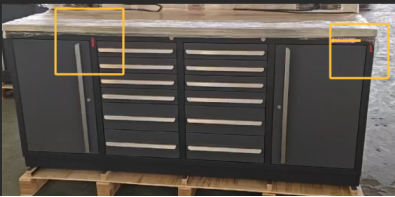
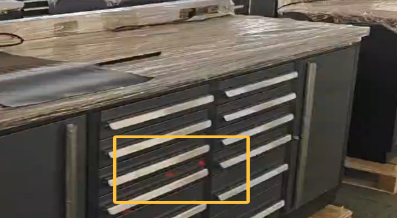
1.Recording and Reporting: Record defect details and report to the quality manager
2.Review and Judgment: The quality, technical, and production departments review the defect and determine its status as: rework, repair, acceptance with concessions, or scrap
3.Handling and Follow-up: Handle the defect according to the review results, re-inspect the handled products, and follow up until closure.
The following video is for reference:
Quality Inspection 001: https://youtube.com/shorts/_2NqO6une_Y
Quality Inspection 002: https://youtu.be/QXzRdQm4SXs
In short, we will do our best to nip any potential problems in the bud before shipment, ensuring quality and reducing customer complaints.
Read More:
How do we handle customer complaints (quality issues) – tool cabinet/tool cart?
As a foreign importer, what costs do you have to bear, especially the implicit costs?
Cost Reduction And Efficiency Improvement In Company Operations
Tool Cabinet / Tool Cart Buying Guide For Auto Repair Shop
Case Study on Supply Chain Cost Reduction and Efficiency Improvement
Customer question: Why is there such a big price difference for the same tool cabinet?
Tool Cabinet/Chest/Box Buying Guide
Tool Cabinet/Chest/Box Recommendations
How to identify your target customer base (in the tool cabinet industry)?
Informe de análisis de ventas de armarios de herramientas en el mercado español 2025
Analyseverslag van de verkoop van gereedschapskasten op de Nederlandse markt 2024-2026
Analyserapport for det norske markedet for verktøyskap 2025
Informe de análisis de ventas de gabinetes de herramientas en el mercado mexicano 2022-2025
Relatório de Análise de Vendas de Armários de Ferramentas no Brasil-2024