

Tool cabinets are used in a wide range of scenarios, encompassing virtually all industrial and commercial environments requiring tool storage, management, and use, even extending to high-end homes and specialized hobby settings. Their core values are safety, efficiency, cleanliness, and professionalism. A detailed analysis of usage scenarios will help you identify your target customer base and better serve your end customers.
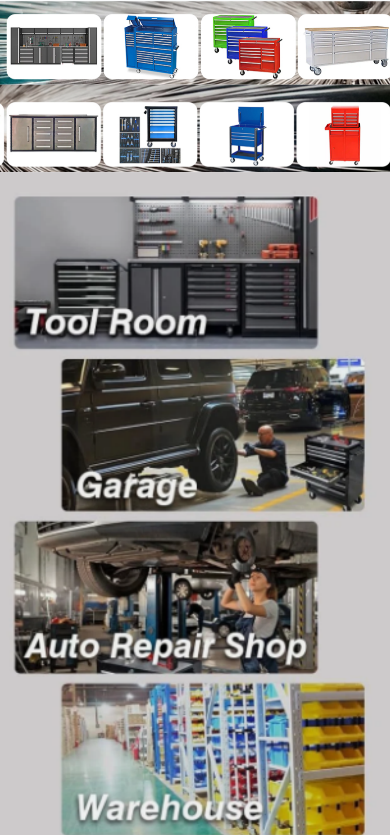
The following is a detailed description of the applications of tool cabinets in different fields and scenarios:
1.Industrial Production and Manufacturing (Core Application Scenario)
This is the most classic and in-demand application for tool cabinets.
1.1 Production Line Workstations in Industrial and Mining Enterprises:
Scenario: In automotive assembly lines, electronics production lines, machining centers, and other areas, each workstation has a tool cabinet.
Purpose: To store all specialized tools, gauges, fixtures, and consumables required by the operator at that workstation, significantly improving production efficiency and reducing errors.
1.2 Maintenance and Repair (MRO):
Scenario: Factory maintenance departments and equipment maintenance teams.
Purpose: Stores various maintenance tools (wrenches, screwdrivers, sockets), test instruments (multimeters, oscilloscopes), spare parts (screws, bearings, seals), and safety equipment (gloves, goggles). A tool cart with wheels serves as a mobile workstation for maintenance engineers, allowing them to be moved to the site of a faulty piece of equipment at any time.
1.3. Quality Control (QC/QA) Room:
Applications: Product quality inspection departments and laboratories.
Purpose: Precision storage of various measuring tools, such as calipers, micrometers, height gauges, and gauge blocks. This type of tool cabinet typically requires protection from dust and moisture, with finely divided compartments and soft padding to protect precision instruments and prevent bumps.
1.4. Mold/Tool Library:
Applications: Injection molding workshops, stamping shops, and CNC machining centers.
Purpose: Stores and manages expensive specialized molds, milling cutters, drill bits, and blades. Tool cabinets protect assets, prevent loss, and maintain organized management. Heavy-duty drawers can hold molds weighing hundreds of kilograms for easy access.
2.Professional Services and Maintenance Industry
2.1. Automotive Repair Shop (4S/Express Repair Shop):
Scenario : The technician’s workspace.
Purpose: This is the most typical public image of a tool cabinet. Technicians will invest in a tool cart with wheels and a top cabinet combination, neatly displaying all their specialized repair tools, such as sockets, wrenches, and diagnostic equipment. It represents the technician’s professionalism and work efficiency.
2.2. Aerospace Maintenance:
Scenario: Aircraft hangar.
Purpose: Storage of specialized tools and equipment required for aircraft maintenance. Management requirements are extremely strict, and FOD (Foreign Object Damage) prevention standards must be adhered to. Tool cabinets are often equipped with intelligent management systems. Each tool has a dedicated location and ID, and access requires registration to ensure that no tools are left inside the aircraft, posing a serious safety hazard.
2.3. Data Center/IT Room Maintenance:
Scenario: Server rooms and near network cabinets.
Purpose: Stores network installation and maintenance tools, such as cable cutters, crimpers, screwdriver sets, testers, spare network cables, modules, and screws. This helps keep the computer room clean and tidy, ensuring tools are readily available and organized.
2.4. Appliance Repair Shop:
Scenario: Repair technician’s work area
Purpose: Stores maintenance tools, ensuring they are readily available and organized.
2.5. Construction Machinery:
Scenario: Machinery maintenance work area
Purpose: Stores repair tools, ensuring they are readily available.
3.Infrastructure and Utilities
3.1. Construction Site:
Scenario: Temporary tool rooms and warehouses on construction sites.
Purpose: Stores large power tools (drills, angle grinders), hand tools (hammers, crowbars), and labor protection equipment (hard hats, safety belts). This type of tool cabinet is typically heavy-duty, rainproof, and lockable, designed for outdoor use, with a focus on tool security and theft prevention.
3.2 Power and Substations, Water and Gas Companies:
Scenes: Engineering rescue vehicles, repair service points.
Purpose: A large tool cabinet installed in the trunk of a rescue vehicle is used to organize and store specialized repair tools, instruments, and key parts, ensuring that all equipment can be quickly dispatched to the scene upon receiving a call.
4.Special and Emerging Fields
4.1. Film and Television Crews/Theaters:
Scenes: Prop rooms, lighting and sound equipment areas.
Purpose: Stores expensive professional film and television lighting, lenses, audio cables, special props, hardware accessories, etc. This facilitates quick access to needed items during the hectic set-up and teardown process, preventing damage.
4.2. High-End Home Garages or Studios:
Scenes: Home garages, storage rooms, DIY workshops, model studios.
Purpose: Stores household tools (for repairs, gardening), hobby tools (for woodworking, leather goods, model making), sports equipment, etc. It not only solves storage problems but also becomes a lifestyle, making hobbies more professional and enjoyable.
4.3. Medical Equipment Maintenance (Laboratory):
Scenario: Hospital Biomedical Engineering Department.
Purpose: Storage of specialized calibration instruments and tools used for the maintenance and repair of medical equipment (such as ventilators and infusion pumps). Cleanliness and strict management are essential.
Summary: The core value of a tool cabinet lies in:
Efficiency Improvement: Quickly locate and access tools, reducing search time.
Tool Protection: Dust, moisture, and impact protection extend tool life.
Safety Management: Locks prevent tool loss and unauthorized use, especially of hazardous tools.
Workplace Cleanliness: Core equipment for 5S/6S site management, creating a safe and orderly work environment.
Professional Image: Neatly managed tools reflect the professionalism and standardization of a company or individual.
The choice of tool cabinet (size, material, drawer configuration, wheeled, anti-static, or intelligent) depends entirely on the specific application scenario and needs.
Read More:
What is our comprehensive quality inspection process? – Tool cabinet/tool cart
How do we handle customer complaints (quality issues) – tool cabinet/tool cart?
Cost Reduction And Efficiency Improvement In Company Operations
Tool Cabinet / Tool Cart Buying Guide For Auto Repair Shop
Case Study on Supply Chain Cost Reduction and Efficiency Improvement
Customer question: Why is there such a big price difference for the same tool cabinet?
Tool Cabinet/Chest/Box Buying Guide
Tool Cabinet/Chest/Box Recommendations
Informe de análisis de ventas de armarios de herramientas en el mercado español 2025
Analyseverslag van de verkoop van gereedschapskasten op de Nederlandse markt 2024-2026
Analyserapport for det norske markedet for verktøyskap 2025
Informe de análisis de ventas de gabinetes de herramientas en el mercado mexicano 2022-2025
Relatório de Análise de Vendas de Armários de Ferramentas no Brasil-2024